A regional coverage page pattern
A layout describing coverage area, hub locations and route reach rather than a single address.
Color scheme
Accent
Saved on this device only.
Regional branch page design answers a different question than a single depot page: not where is your address, but which regions do you actually cover, which is the detail a shipper or partner checks before anything else.
What it costs
Transport, logistics and line-haul networks, and utility or field service fleets, where buyers judge you on regional coverage and capacity rather than on one street address.
A network covering lanes through Texas, California, Florida and Georgia is assessed region by region, so each regional page describes the lanes, hubs and capacity in that region.
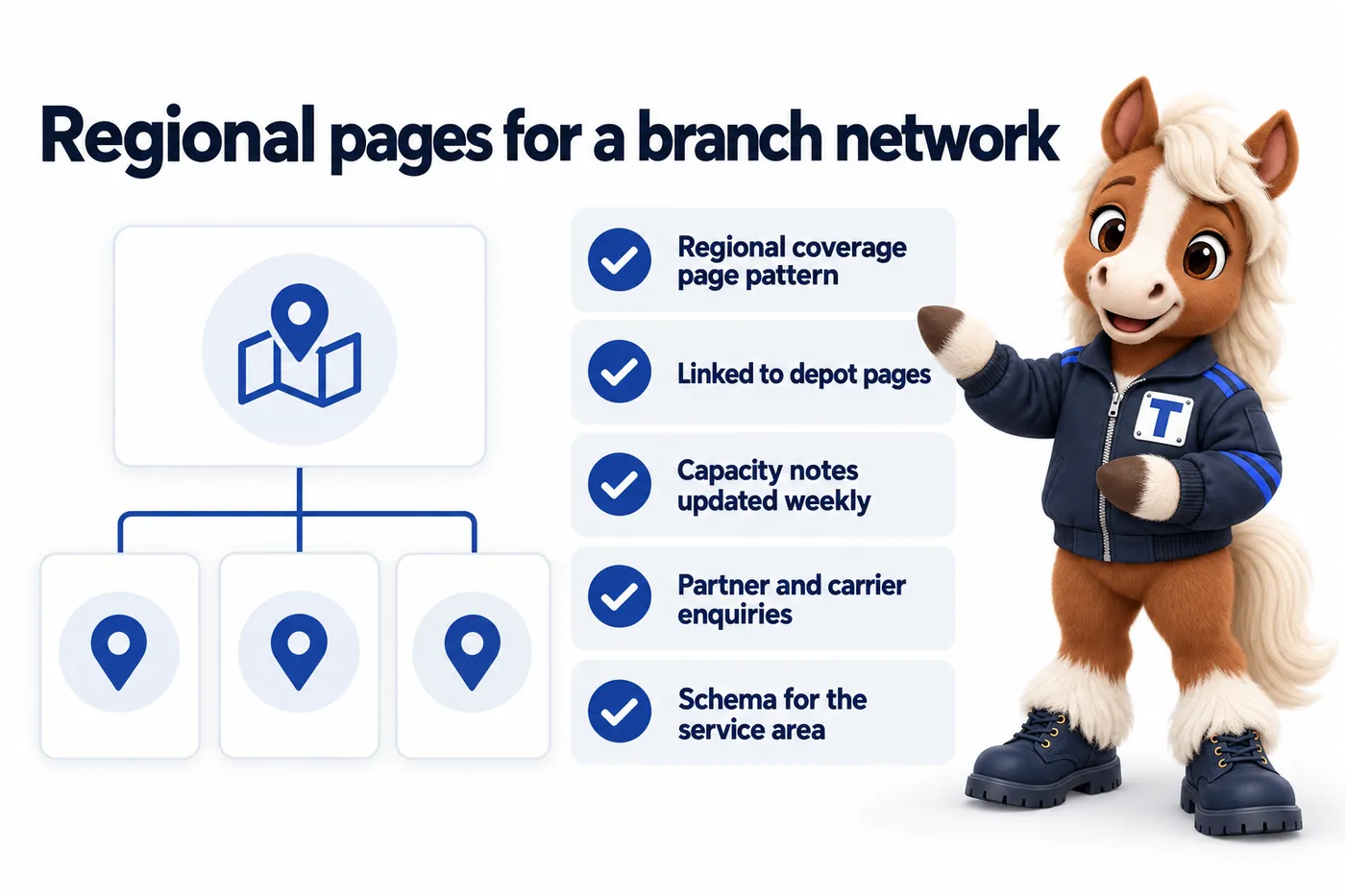
A logistics or line-haul network is evaluated on the regions it reaches, so a regional branch page describes coverage area, hub locations and route reach rather than a single street address, which is what a national account or partner actually needs to assess fit.
Regional pages complement rather than replace individual depot or hub pages. A visitor evaluating overall network reach lands on the regional page; one looking for a specific pickup or drop-off point lands on the depot page linked from it.
Regional capacity changes with the season and with contract wins, so the page is built to take a weekly update on capacity notes without needing a redesign each time conditions change.
A layout describing coverage area, hub locations and route reach rather than a single address.
Regional pages connected to the specific depot or hub pages within that region.
A section designed to reflect seasonal or contract-driven capacity changes without a redesign.
A form structured for a partner or carrier enquiry, separate from a general public contact form.
Structured data appropriate to a regional service area rather than a single business address.
Also on every plan: hosting, a domain in your name, weekly updates, 5 revisions a month, researched articles, schema markup and compliance pages. See every feature.
Shippers ask which regions you cover before they will quote.
Your coverage is described in one sentence on the About page.
Capacity changes seasonally and the site never reflects it.
Partner and carrier enquiries arrive mixed with general questions.
A 30-minute demo, on your screen, of what this would look like with your vehicle classes and depots.
Regional branch page design is part of every plan rather than a separate project, so the price is the plan you choose. What changes the cost is the plan, extra revisions beyond 5 a month, and AI usage on the plans that include the AI Engine.
Regions, hubs and lanes you genuinely cover, agreed with you.
A regional page layout for coverage, hubs and capacity notes.
Regional pages linked to each depot or hub page inside them.
Partner and carrier enquiries routed apart from general ones.
Plainly, so there are no surprises after you order:
They built the FAQ from our actual commercial fleet inquiries correspondence. The recurring questions were pulled out, rewritten clearly, and approved line by line by our team. I now share a link instead of digging through the outbox.
GotFAQ research and editorial review for commercial fleet inquiries
Patrick Paddington
Operations manager, regional commercial vehicle hire
Stamford, Connecticut · Manifest
Our commercial fleet inquiries information finally sits beside the contact details that belong with it. The location travels with the inquiry now, so we stop asking people where they meant to reach. It removed an irritation on both sides of the phone line.
GotLocation information and contact routing for commercial fleet inquiries
Padma Rathore
Depot coordinator, seasonal delivery van hire
Provo, Utah · Manifest
We are not a fleet operator, vehicle leasing company or rental agency. We build and run the website; the vehicles, terms and compliance stay with you. Conditions are in the terms and conditions.
A depot page documents one location; a regional page documents coverage across several depots or an entire service area, which is the detail a network-level buyer actually evaluates.
Yes. Capacity notes are built to take a weekly update as a normal revision, since regional capacity changes with season and contract wins.
Yes. The enquiry form on a regional page can be configured to route partner or carrier requests differently from general public enquiries.
No. Regional pages document the coverage you actually operate. We do not claim a service area beyond what your business genuinely reaches.
Yes. A map or a clear list of areas served can be part of the regional page, built so it stays fast and readable on a phone.
Weekly. Capacity notes are part of the weekly update, so seasonal changes and contract wins can be reflected without a redesign.
Yes, for searches that name a region or a lane. They sit alongside depot pages, which cover searches for a specific town.
On Register and Dispatch, the AI receptionist can take partner and carrier details and pass them to the right desk, with anything needing judgment handed to a person.
A live walk-through of the site you would get, in about 30 minutes. Plans from $127 a month, the $697 build fee invoiced only after launch, domain and hosting included.
Book a demoOr email and a person replies within one working day. Weighing this against a builder, a freelancer or an agency? Read the ten comparisons.
FleetWebStudio uses the cookies below. Necessary cookies keep the site working and cannot be turned off.
Saved on this device only. Press Esc to close.