Service level page architecture
A structured, documented layout for service level and SLA content, built for a procurement reader.
Color scheme
Accent
Saved on this device only.
A fleet management company needs website development that treats service level detail and fleet capacity as core content, not an afterthought bolted onto a generic business template.
What it costs
Fleet management companies and corporate fleet desks that sell a documented service, with service levels, reporting and vehicle specifications, to procurement panels who compare suppliers on paper before they meet anyone.

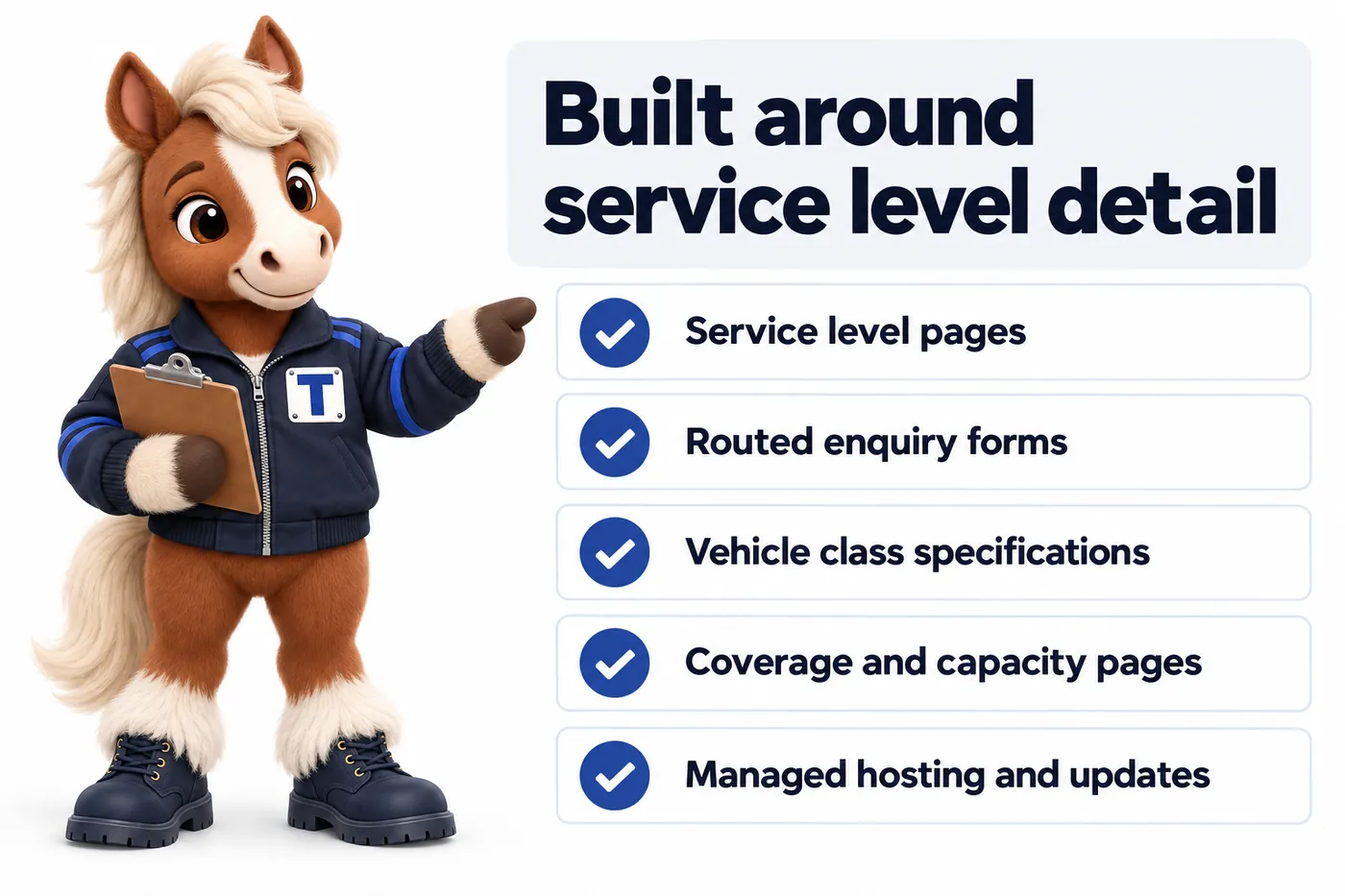
A fleet management company sells a documented service, so development starts from the pages that carry that documentation: service level pages, vehicle class specification pages and coverage pages, each built as its own structured page rather than paragraphs on a single About page.
A fleet management enquiry usually needs to reach a specific desk or account manager, not a general inbox. Development includes routing rules configured with your CRM or transport management system, so an enquiry from a request for proposal lands with the right person automatically.
As you take on new client accounts or expand fleet capacity, the site needs new pages, not a new build. The development pattern used for vehicle class and coverage pages supports that growth as a revision rather than a redevelopment project.
Procurement asks for service level detail that is not on your site.
RFP-stage enquiries arrive through a generic contact form with half the detail missing.
Different regions or desks need enquiries routed to different people.
Your capacity and coverage have grown but the site still describes last year's operation.
Service levels, coverage and capacity laid out as documented pages.
One page per vehicle class with the detail a procurement reviewer expects.
A structured enquiry capturing fleet size, mix, term and region, routed by desk.
Capacity and coverage updated weekly as contracts change.
A 30-minute demo, on your screen, of what this would look like with your vehicle classes and depots.
A structured, documented layout for service level and SLA content, built for a procurement reader.
Enquiries connected into your CRM or transport management system, with routing rules to the right desk.
A repeatable pattern for documenting vehicle classes with the detail a procurement buyer expects.
Pages describing regional coverage and fleet capacity rather than a single generic service area line.
Hosting, weekly updates and ongoing development handled as part of your plan.
Also on every plan: hosting, a domain in your name, weekly updates, 5 revisions a month, researched articles, schema markup and compliance pages. See every feature.
What I value about the commercial fleet inquiries guide is its restraint. Visitors arrive knowing what the first discussion covers and what they should think about beforehand. The link now goes out with our reply to every new inquiry.
GotPreparation guide and inquiry support for commercial fleet inquiries
Matthew Moorcroft
Business accounts lead, accessible vehicle hire specialist
Knoxville, Tennessee · Manifest
They pushed us to be precise about commercial fleet inquiries, which felt slow at first and right at the end. The boundaries are drawn clearly: what the site settles, and what our people still decide. The awkward 'that's not quite what we meant' conversation has largely disappeared.
GotService scope and expectations for commercial fleet inquiries
Talib Salman
Rental desk supervisor, small business fleet leasing firm
Naperville, Illinois · Manifest
Fleet management company website development is part of every plan rather than a separate project, so the price is the plan you choose. What changes the cost is the plan, extra revisions beyond 5 a month, and AI usage on the plans that include the AI Engine.
Plainly, so there are no surprises after you order:
We are not a fleet operator, vehicle leasing company or rental agency. We build and run the website; the vehicles, terms and compliance stay with you. Conditions are in the terms and conditions.
Yes. A side-by-side comparison of your service level packages is a standard development request, built with the same ruled layout used across the rest of the site.
Enquiry routing is configured during onboarding to match your internal process, so requests can be tagged and sent to a specific desk or account manager automatically.
Yes, as a revision. The page pattern used for coverage and vehicle class content supports new additions without a new development project.
No. We build the page structure; the compliance, licensing and service level content itself is yours to supply, since we are not a fleet operator.
Yes. Specification sheets you supply can be published as downloads alongside the vehicle class pages, and updated as a revision.
That is the point of the build. Service levels, coverage and capacity get their own documented pages, written answer-first so a reviewer can extract them quickly.
On Register and Dispatch it can answer common questions and take details, and it hands anything needing judgment, such as pricing for a tender, to a person.
Yes, where you supply real examples and your client agrees. We never invent a client, a figure or an outcome.
A live walk-through of the site you would get, in about 30 minutes. Plans from $127 a month, the $697 build fee invoiced only after launch, domain and hosting included.
Book a demoOr email and a person replies within one working day. Weighing this against a builder, a freelancer or an agency? Read the ten comparisons.
FleetWebStudio uses the cookies below. Necessary cookies keep the site working and cannot be turned off.
Saved on this device only. Press Esc to close.