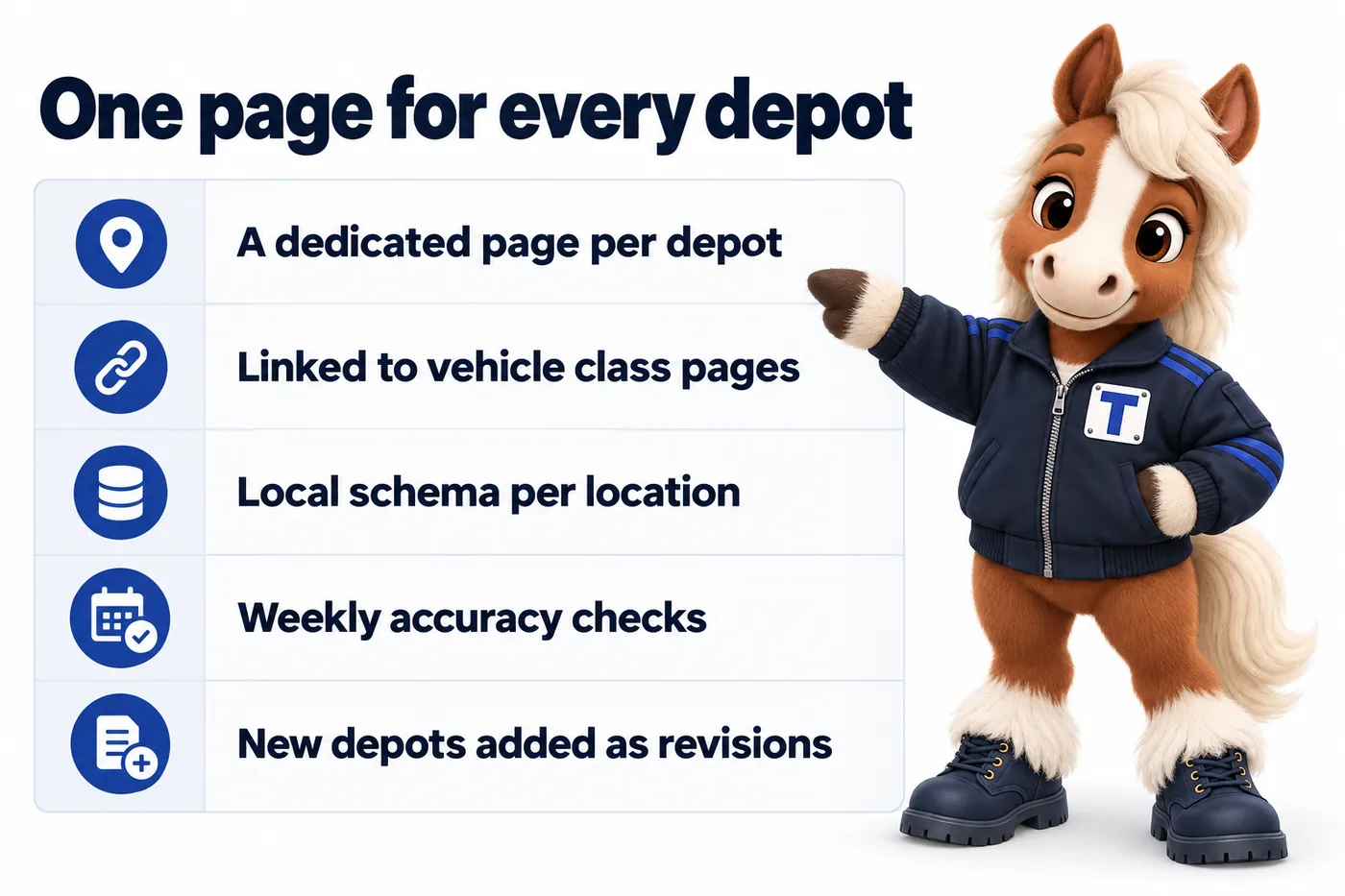
A dedicated page per depot
Address, hours, coverage area and fleet on hand, documented individually for every location.
Color scheme
Accent
Saved on this device only.
Multi-depot location pages work when each branch gets its own dedicated page rather than a shared list, because a buyer searching for a depot near them needs a specific answer, and a search engine needs a specific page to rank for it.
What it costs
Operators running two or more yards, branches or pickup points, from a regional van hire business to a national contract hire provider with depots in several states.
A depot in Dallas and another in Atlanta face different local competitors, so each page is written about its own location. Operators with yards across Texas, California, Florida, Georgia, Illinois and Ohio get a page per yard, never one page with the city name swapped.
Your site lists every depot on one "locations" page.
Searches near a secondary depot show competitors instead of you.
Each yard stocks different classes but the site shows one fleet list.
Opening a depot means waiting for a developer to add it.
Address, hours, coverage area and fleet on hand, documented individually for every location.
Each depot linked to the vehicle classes it stocks, in both directions.
Structured data matched to each depot page so search engines associate the right content with the right place.
Depot hours and fleet notes reviewed and updated every week as part of your plan.
Opening a new branch adds a page from the same pattern, without a new development project.
Also on every plan: hosting, a domain in your name, weekly updates, 5 revisions a month, researched articles, schema markup and compliance pages. See every feature.
Every depot page names its own address, opening hours, the vehicle classes stocked there and the fastest way to reach that specific location. That level of detail is what separates a real location page from a shared "find us" list that treats every branch identically.
Each depot page links to the vehicle class pages it actually stocks, and each vehicle class page links to the depots that carry it. That crossing is what lets a search for a specific vehicle in a specific area resolve to a real, relevant page.
Opening a new depot means adding one more page from the same pattern, handled as a revision within your plan's turnaround window. The architecture is built for a fleet that grows, not just the one you operate on day one.
A 30-minute demo, on your screen, of what this would look like with your vehicle classes and depots.
Address, hours, contact and classes stocked for every yard.
Unique copy about each location and the area it serves.
LocalBusiness schema per depot; links to and from class pages.
Each new depot goes live as one revision.
Our commercial fleet inquiries information finally sits beside the contact details that belong with it. The location travels with the inquiry now, so we stop asking people where they meant to reach. It removed an irritation on both sides of the phone line.
GotLocation information and contact routing for commercial fleet inquiries
Padma Rathore
Depot coordinator, seasonal delivery van hire
Provo, Utah · Manifest
I never trusted pageview counts; what I wanted was to know where commercial fleet inquiries began. Submissions carry their originating page, so content and inquiries can finally be compared. It gives us a better question to ask of every page.
GotBasic inquiry source reporting for commercial fleet inquiries
Rowena Denham
Commercial hire supervisor, business van and car hire company
Naperville, Illinois · Manifest
We are not a fleet operator, vehicle leasing company or rental agency. We build and run the website; the vehicles, terms and compliance stay with you. Conditions are in the terms and conditions.
Multi-depot location pages is part of every plan rather than a separate project, so the price is the plan you choose. What changes the cost is the plan, extra revisions beyond 5 a month, and AI usage on the plans that include the AI Engine.
Plainly, so there are no surprises after you order:
As many as you operate. There is no separate charge per depot page; adding one is handled as one of your included monthly revisions.
Yes. Depot pages are written individually, so the vehicle classes, hours and coverage shown match exactly what that location actually offers.
The page is updated or redirected as a revision, and any links from vehicle class pages pointing to it are updated at the same time.
Yes. A dedicated, accurate page per location is one of the clearest signals a search engine uses to understand and rank a business across several places.
No. Build as many depot pages as you operate. After launch, a new depot is one revision, and 5 are included every month.
Each page is written about its own location: the area it serves, the classes stocked there, its hours and access. We never publish the same text with the town name swapped.
Yes. Each depot page can show its own number and route enquiries to that yard or desk, configured during onboarding.
Availability notes are updated weekly from what you send us. Live stock feeds depend on your own system and would be scoped with you first.
A live walk-through of the site you would get, in about 30 minutes. Plans from $127 a month, the $697 build fee invoiced only after launch, domain and hosting included.
Book a demoOr email and a person replies within one working day. Weighing this against a builder, a freelancer or an agency? Read the ten comparisons.
FleetWebStudio uses the cookies below. Necessary cookies keep the site working and cannot be turned off.
Saved on this device only. Press Esc to close.