Rate and terms display components
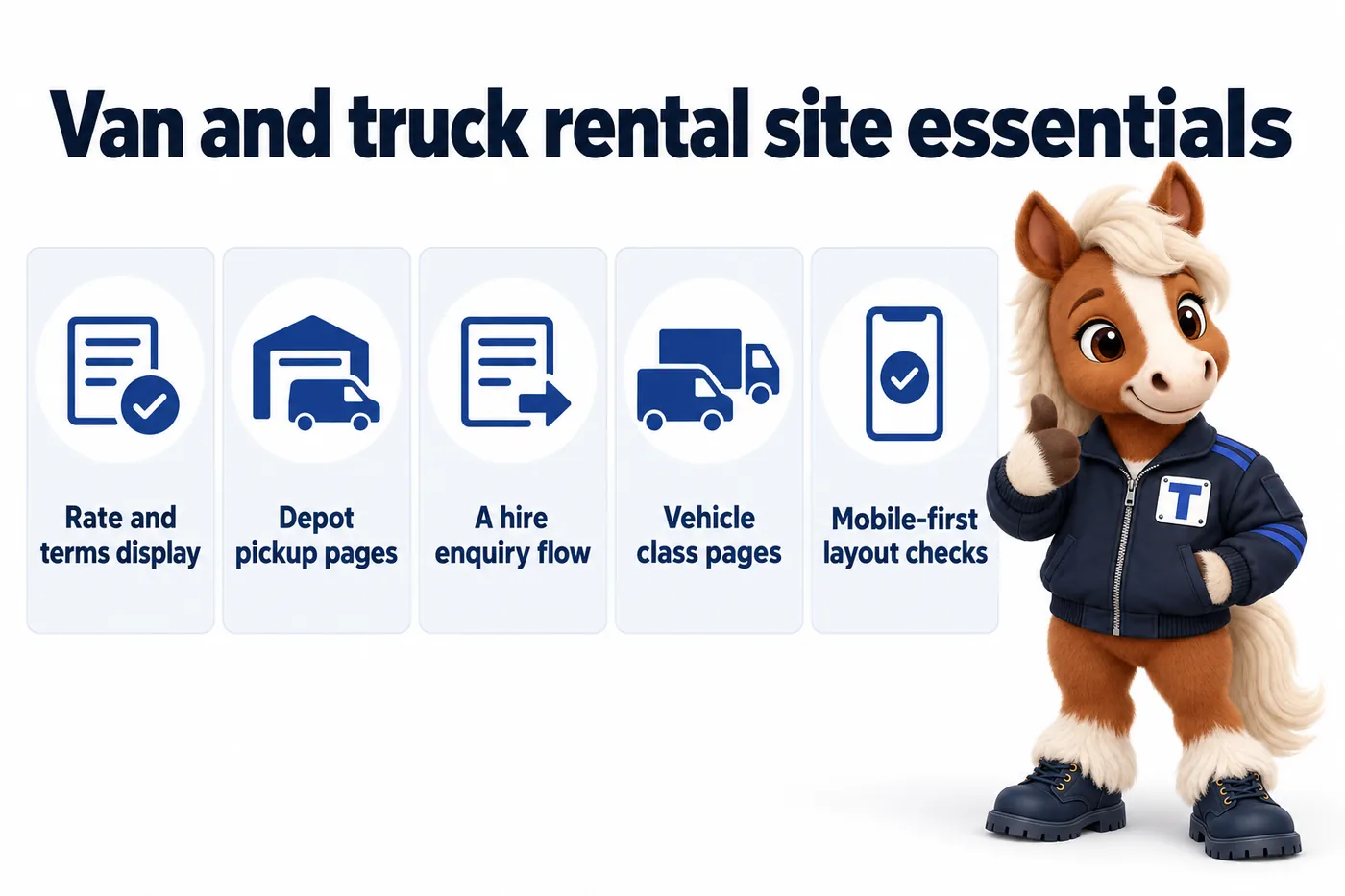
A clear, ruled way to show indicative rate ranges and hire terms per vehicle class, always labelled as examples where figures are illustrative.
Color scheme
Accent
Saved on this device only.
A van and truck rental website works when rates, vehicle classes and pickup depots are visible before a visitor has to ask, so the design is built around that decision path from the first screen.
What it costs
Short and mid-term van and truck rental operators, from a single yard renting box trucks to a regional network hiring vans, pickups and refrigerated units, whose customers compare two or three operators in one sitting.

Customers call to ask for rates that could be shown as ranges on the page.
Pickup and return rules differ by yard but the site has one generic terms page.
Most visits come from phones and the enquiry form is awkward to fill in on one.
Seasonal demand spikes and the site cannot flag capacity without a developer.
A hire customer comparing several operators in one sitting does not wait for a call back to see whether your rates and terms fit their trip. The design surfaces indicative rate ranges or terms clearly on each vehicle class page, so a comparison-stage visitor can shortlist you without friction.
Pickup and return logistics vary by depot, so each depot gets its own page with hours, address and available vehicle classes designed as a first-class page rather than a footer link. That structure is what lets a hire operator with several depots read clearly instead of blurring into one generic location statement.
The booking or enquiry flow asks for vehicle class, dates and pickup depot up front, styled to feel like the next step in a decision rather than a wall stopping the visitor. That is what turns a comparison-stage visit into a completed enquiry.
Van and truck rental website design is part of every plan rather than a separate project, so the price is the plan you choose. What changes the cost is the plan, extra revisions beyond 5 a month, and AI usage on the plans that include the AI Engine.
A 30-minute demo, on your screen, of what this would look like with your vehicle classes and depots.
A clear, ruled way to show indicative rate ranges and hire terms per vehicle class, always labelled as examples where figures are illustrative.
A repeatable page pattern covering address, hours and fleet on hand for every pickup and return location.
A structured form asking for vehicle class, dates and depot, styled to feel like progress rather than a barrier.
One page per vehicle class, each with its own terms and specification detail.
Every page checked at phone width, since a hire decision is often made from a phone mid-comparison.
Also on every plan: hosting, a domain in your name, weekly updates, 5 revisions a month, researched articles, schema markup and compliance pages. See every feature.
We agree whether you publish indicative rate ranges or run enquiry-only, then lay out terms per class.
Each pickup and return point gets its own page with hours and classes on site.
A short form asking class, dates and pickup depot, routed into your system.
Rates and availability notes updated every week from what you send us.
I tested the commercial fleet inquiries page on my own phone before we approved anything. Everything a visitor needs is up top, and the inquiry button stands out properly. It is far more practical than the old page when we share it with a caller.
GotMobile navigation and page layout for commercial fleet inquiries
Wendy Sinclair
Fleet administrator, last-mile delivery van rental
Springfield, Missouri · Manifest
Splitting new commercial fleet inquiries from follow-ups sounded minor and was not. The sender picks the route, which means the best-informed person does the sorting. Our inbox finally reads like the conversations it actually contains.
GotInquiry categories and guided navigation for commercial fleet inquiries
Edward Huxley
Fleet desk administrator, event logistics vehicle hire
Albuquerque, New Mexico · Manifest
We are not a fleet operator, vehicle leasing company or rental agency. We build and run the website; the vehicles, terms and compliance stay with you. Conditions are in the terms and conditions.
Plainly, so there are no surprises after you order:
Either works. Some hire operators publish indicative rate ranges clearly labelled as examples, others prefer an enquiry-only flow. We design around whichever your business runs.
Yes. Short-term and long-term hire are built as separate, clearly labelled sections so a visitor comparing options is never confused about which terms apply.
Yes. Each depot page carries its own hours and fleet detail, so pickup logistics are accurate location by location rather than generalised.
Yes. A seasonal note or capacity flag is a normal revision, since the layout system is built to take content updates without needing new design work each time.
The site routes structured hire enquiries into your booking or CRM system rather than processing bookings or payments itself. We are not a rental agency; your own system confirms the hire.
Yes. Every page is checked at phone widths and guaranteed 90+ on Google PageSpeed, because most hire decisions are made on a phone mid-comparison.
On Register and Dispatch, an AI chat agent and receptionist answer common questions such as minimum hire period or which yard stocks a class, and take the enquiry details for your desk.
Yes. Short-term and long-term terms are laid out separately, and seasonal notes can be added as a revision whenever you need them.
A live walk-through of the site you would get, in about 30 minutes. Plans from $127 a month, the $697 build fee invoiced only after launch, domain and hosting included.
Book a demoOr email and a person replies within one working day. Weighing this against a builder, a freelancer or an agency? Read the ten comparisons.
FleetWebStudio uses the cookies below. Necessary cookies keep the site working and cannot be turned off.
Saved on this device only. Press Esc to close.